Sunday, July 1, 2012

Getting Star Trek on the air was impossible

From the Letters of Note Blog

Getting Star Trek on the air was impossible


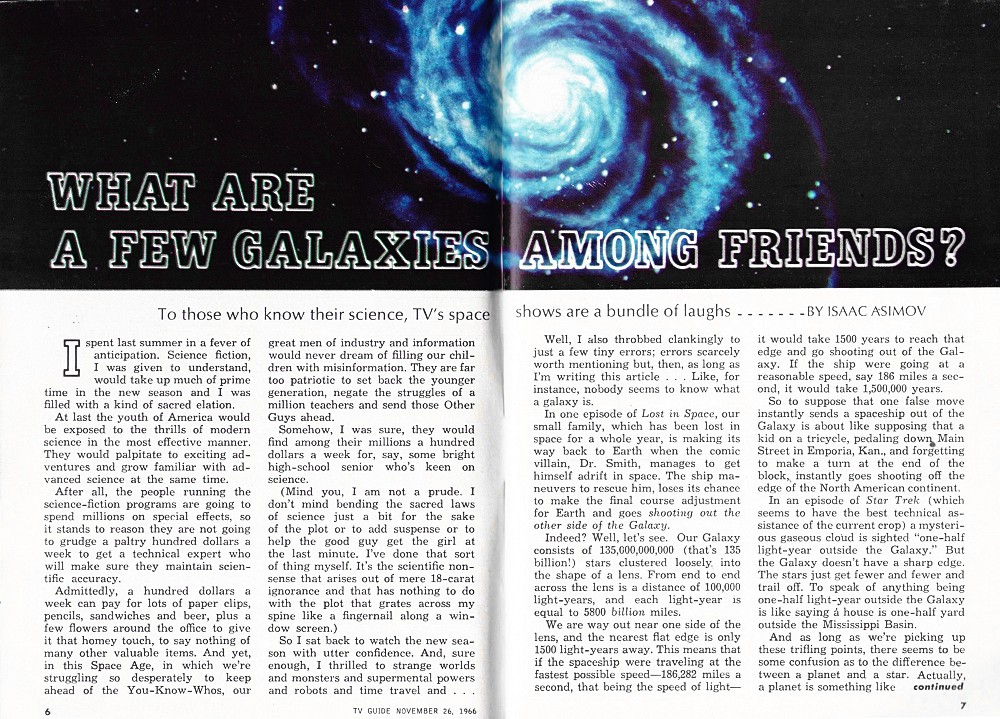
In November of 1966, two months after the first Star Trek series premièred in the U.S., science fiction author Isaac Asimov wrote an article for TV Guide in which he complained about the numerous scientific inaccuracies found in science fiction TV shows of the day — Star Trek included. That show's creator, Gene Roddenberry, didn't take kindly to the jab, and immediately wrote to Asimov with a polite but stern response that also went some way to explaining the difficulties of bringing such a show to the screen. His letter can be read below.

Asimov apologised, and in fact became a good friend of Roddenberry's and an advisor to the show. Also below is a fascinating exchange of theirs that took place some months later, just as a problem arose relating to the relationship between Captain Kirk and Spock — a potentially damaging problem that Asimov helped to solve.

(Source: Star Trek Creator: The Authorized Biography of Gene Roddenberry; Images of Gene Roddenberry & Isaac Asimov via here & here.)

29 November, 1966

Dear Isaac:

Sorry I had to address it in this round-about way since I did not have your address and Harlan Ellison, who might have supplied it, is working a final draft for us and is already a week late and I don't want to take his attention away from it for even a moment. On second thought, I believe he is a month or two late.

Wanted to comment on your TV Guide article, "What Are A Few Galaxies Among Friends?"

Enjoyed it as I enjoy all your writing. And it will serve as a handy reference to those of our Star Trek writers who do not have a SF background. Although, to be perfectly honest, those with SF background and experience tend to make the same mistakes. I've found that the best SF writing is no guarantee of science accuracy.

A person should get his facts straight when writing anything. So, as much as I enjoyed your article, I am haunted by this need to write you with the suggestion that some of your facts were not straight. And, just as a writer writing about science should know what a galaxy is, a writer writing about television has an obligation to acquaint himself with pertinent aspects of that field. In all friendliness, and with sincere thanks for the hundreds of wonderful hours of reading you have given me, it does seem to me that your article overlooked entirely the practical, factual and scientific problems involved in getting a television show on the air and keeping it there. Television deserved much criticism, not just SF alone but all of it, but that criticism should be aimed, not shot-gunned. For example, Star Trek almost did not get on the air because it refused to do a juvenile science fiction, because it refused to put a "Lassie" aboard the space ship, and because it insisted on hiring Dick Matheson, Harlan Ellison, A.E. Van Vogt, Phil Farmer, and so on. (Not all of these came through since TV scripting is a highly difficult specialty, but many of them did.)

In the specific comment you made about Star Trek, the mysterious cloud being "one-half light-year outside the Galaxy," I agree certainly that this was stated badly, but on the other hand, it got past a Rand Corporation physicist who is hired by us to review all of our stories and scripts, and further, got past Kellum deForest Research who is also hired to do the same job.

And, needless to say, it got past me.

We do spend several hundred dollars a week to guarantee scientific accuracy. And several hundred more dollars a week to guarantee other forms of accuracy, logical progressions, etc. Before going into production we made up a "Writer's Guide" covering many of these things and we send out new pages, amendments, lists of terminology, excerpts of science articles, etc., to our writers continually. And to our directors. And specific science information to our actors depending on the job they portray. For example, we are presently accumulating a file on space medicine for De Forest Kelly who plays the ship's surgeon aboard the USS Enterprise. William Shatner, playing Captain James Kirk, and Leonard Nimoy, playing Mr. Spock, spend much of their free time reading articles, clippings, SF stories, and other material we send them.

Despite all of this we do make mistakes and will probably continue to make them. The reason—Thursday has an annoying way of coming up once a week, and five working days an episode is a crushing burden, an impossible one. The wonder of it is not that we make mistakes, but that we are able to turn out once a week science fiction which is (if we are to believe SF writers and fans who are writing us in increasing numbers) the first true SF series ever made on television. We like to think this is what we are trying to do, and trying with considerable pride. And I suppose with considerable touchiness when we believe we are criticized unfairly or as in the case of your article, damned with faint praise. Quoting Ted Sturgeon who made his first script attempt with us (and now seems firmly established as a contributor to good television), getting Star Trek on the air was impossible, putting out a program like this on a TV budget is impossible, reaching the necessary mass audience without alienating the select SF audience is impossible, not succumbing to network pressure to "juvenilize" the show is impossible, keeping it on the air is impossible. We've done all of these things. Perhaps someone else could have done it better, but no one else did.

Again, if we are to believe our letters (now mounting into the thousands), we are reaching a vast number of people who never before understood SF or enjoyed it. We are, in fact, making fans—making future purchasers of SF magazines and novels, making future box office receipts for SF films. We are, I sincerely hope, making new purchasers of "The Foundation" novels, "I, Robot," "The Rest of the Robots," and other of your excellent work. We, and I personally, in our own way and beset with the strange problems of this mass communications media, work as proudly and as hard as any other SF writer in this land.

If mention was to be made of SF in television, we deserved much better. And, as much as I admire you in your work, I felt an obligation to reply.

And, I believe, the public deserves a more definitive article on all this. Perhaps TV Guide is not the marketplace for it, but if you ever care to throw the Asimov mind and wit toward a definitive TV piece, please count on us for facts, figures, sample budgets, practical production examples, and samples of scripts from rough story to the usual multitude of drafts, samples of mass media "pressure," and whatever else we can give you.

Sincerely yours,

Gene Roddenberry

-----------------------

[Seven months later...]

June, 1967

Dear Isaac,

Wish you were out here.

I would dearly love to discuss with you a problem about the show and the format. It concerns Captain James Kirk and of course the actor who plays that role, William Shatner. Bill is a fine actor, has been in leads on Broadway, has done excellent motion pictures, is generally rated as fine an actor as we have in this country. But we're not getting the use of him that we should and it is not his fault. It's easy to give good situations and good lines to Spock. And to a lesser extent the same rule is true of the irascible Dr. McCoy. I guess it's something like doing a scene with several businessmen in a room with an Eskimo. The interesting and amusing situations, the clever lines, would tend to go to the Eskimo. Or in our case, the Eskimos.

And yet Star Trek needs a strong lead, an Earth lead. Without diminishing the importance of the secondary continuing characters. But the problem we generally find is this—if we play Kirk as a true ship commander, strong and hard, devoted to career and service, it too often makes him seem unlikable. On the other hand, if we play him too warm-hearted, friendly and so on, the attitude often is "how did a guy like that get to be a ship commander?" Sort of a damned if he does and damned if he doesn't situation. Actually, although it is missed by the general audience, it is Kirk's fine handling of a most difficult role that permits Spock and the others to come off as well as they do. But Kirk does deserve more and so does the actor who plays him. I am in something of a quandary about it.

Got any ideas?

Gene

-----------------------

Gene,

In some way, this is the example of the general problems of first banana/second banana. The star has to be a well-rounded individual but the supporting player can be a "humorous" man in the Elizabethan sense. He can specialize. Since his role is smaller and less important, he can be made highly seasoned, and his peculiarities and humors can easily win a wide following simply because they are so marked and even predictable. The top banana is disregarded simply because he carries the show and must do many things in many ways. The proof of the pudding is that it is rare for a second banana to be able to support a show in his old character if he keeps that character. There are exceptions. Gomer Pyle made it as Gomer Pyle (and acquired a second banana of his own in the person of the sergeant.)

Undoubtedly, it is hard on the top banana (who like all actors has a healthy streak of insecurity and needs vocal and constant reassurance from the audience) to not feel drowned out. Everybody in the show knows exactly how important and how good Mr. Shatner is, and so do all the actors, including even Mr. Shatner. Still, when the fan letters go to Mr. Nimoy and articles like mine concentrate on him, one can't help feeling unappreciated.

What to do? Well, let me think about it and write another letter in a few days. I don't know that I'll have any magic solutions, but you know, some vagrant thought of mine might spark some thought in you and who knows.

Isaac

[A few weeks later...]

Gene,

I promised to get back to you with my thoughts on the question of Mr. Shatner and the dilemma of playing against such a fad-character as "Mr. Spock."

The more I think about it, the more I think the problem is psychological. That is, Star Trek is successful, and I think it will prove easier to get a renewal for the third year than was the case for the second. The chief practical reason for its success Mr. Spock. The excellence of the stories and the acting brings in the intelligent audience (who aren't enough in numbers, alas, to affect the ratings appreciably) but Mr. Spock brings in the "teenage vote" which does send the ratings over the top. Therefore, nothing can or should be done about that. (Besides, Mr. Spock is a wonderful character and I would be most reluctant to change him in any way.)

The problem, then, is how to convince the world, and Mr. Shatner, that Mr. Shatner is the lead.

It seems to me that the only thing one can do is lead from strength. Mr. Shatner is a versatile and talented actor and perhaps this should be made plain by giving him a chance at a variety of roles. In other words, an effort should be made to work up story plots in which Mr. Shatner has an opportunity to put on disguises or take over roles of unusual nature. A bravura display of his versatility would be impressive indeed and would probably make the whole deal a great deal more fun for Mr. Shatner. (He might also consider that a display of virtuosity would stand him in great stead when the time—the sad time—came that Star Trek had finished its run and he must look elsewhere.)

Then, too, it might be well to unify the team of Kirk and Spock a bit, by having them actively meet various menaces together with one saving the life of the other on occasion. The idea of this would be to get people to think of Kirk when they think of Spock.

And, finally, the most important suggestion of all—ignore this letter, unless it happens to make sense to you.

Isaac

-----------------------

Isaac,

Your comments on Shatner and Spock were most interesting and I have passed them on to Gene Coon and others. We've followed one idea immediately, that of having Spock save his Captain's life, in an up-coming show. I will follow your advice about having them much more a team, standing more closely together. As for having Shatner play more varied roles, we have been looking in that direction and will continue to do so.

But I think the most important comment is that of keeping them a close team. Shatner will come off ahead by showing he is fond of the teenage idol; Spock will do well by displaying great loyalty to his Captain.

In a way it will give us one lead, the team.

Gene

Thursday, June 28, 2012

China’s space exploration has various implications for Africa

From Citizen Daily: <a href="http://thecitizen.co.tz/editorial-analysis/-/23504-chinas-space-exploration-has-various-implications-for-africa">China’s space exploration has various implications for Africa </a>   

When the spacecraft Shenzhou 9 blasted skywards last Saturday, millions of Chinese applauded yet another feat of the oriental nation’s steady technological gains. While Chinese media have been awash with the pride that comes with sending a female astronaut alongside two male colleagues into space, the significance of this latest space exploration mission is more than merely gender representation.
<P>
Liu Yang undoubtedly goes into the history books as the first Chinese woman to do so. Indeed, her involvement in the programme will help answer as such puzzles as: Do men and women respond differently to the space environment?
<P>
But perhaps more important is that China has over the past two decades been largely going it alone in efforts to set up a space station after exclusion from the five-nation International Space Station (ISS) programme by a US veto. If all goes according to plan, China will have its own fully fledged space station orbiting over 300 kilometres from earth in the next decade.
<P>
This will be a huge boost not only for China’s scientific advancement but also her global reputational capital.
Among other reasons motivating the US to exclude China from the ISS—jointly run with Russia, Japan, Canada and the European Union—is the jitters that China could appropriate space technology for military purposes. While the European Space Agency seems to have been at ease with China’s involvement in the ISS, the US has maintained a nay position as witnessed by the tightening of laws in 2011 that put paid to the possibility of such co-operation any time soon.
<P>
Russia has independently co-operated with China but has been limited to the rules of engagement as far as invitation of China to the ISS goes. An assumption can be made that Japan, a traditional geopolitical competitor of China’s, would equally block China from going aboard the ISS.
<P>
With this in mind, one can appreciate the effervescent mood throughout China over the weekend as the country inched closer to owning a space station. But the Champagne bottles will truly pop when the final “building blocks” fall in place and China inaugurates an independent space station in 2020 or thereabouts.
<P>
The symbolism of China’s space exploration achievements is evident in the choice of the name Shenzhou for the spacecraft—it translates into heavenly or divine craft, the  same name that China has used to identify itself at various stages in its 5,000-plus continuous civilisation.
<P>
Shenzhou’s mission is to link or dock with the prototype satellite named Tiangong which has been orbiting space since September last year. Tiangong means heavenly palace in Chinese. Both Shenzhou and Tiangong were blasted into space by the Long March carrier rocket. Long March calls to mind the Chinese Communist Party’s arduous war leading to the 1949 promulgation of the People’s Republic of China.
<P>
China’s advancement in space exploration has various implications for African countries over and above benefits to humanity.
Away from the fanfare and geopolitical developments that are a subtle throwback to the US-Russia space race of the 1960s, China’s latest achievements will contribute to the search for answers to a wide range of planetary phenomena—from climate change to communication technologies.
With few resources to mount their own space programmes, African countries now have greater choice in benefiting from the scientific proceeds of space exploration beyond NASA or ESA.
<P>
 The conditionality and costs of accessing technologies currently associated with space science will almost predictably fall as a direct result of greater availability.    The greater latitude for African countries in negotiating for space technologies from China will certainly increase the “Look East” attraction and can

Tuesday, June 26, 2012

The Most Important Milestone from China’s Impressive Week of Exploration

From Wired:  The Most Important Milestone from China’s Impressive Week of Exploration

The seafloor from the Alvin submersible; the Earth from an Apollo mission (Image credits: Jeffrey Marlow; NASA)
A very unusual phone call took place over the weekend, and it happened in Chinese.  Both callers were in cramped metal tins with two other people, but the views from their dinner plate-sized windows could not have been more different.  One man looked out to see 7,000 meters of Pacific Ocean water above his submarine; the other saw the arc of the Earth below his space ship and the vast darkness of space in all other directions.
This clever bit of PR underscores an obvious point: it’s been a good week for China’s sea and space exploration programs, as well as for superlative-hunting historians.  It began on June 16th, when the Shenzhou 9 launched China’s first female taikonaut – Liu Yang – as a member of the three-person crew.  This was the country’s fourth manned mission, and it featured a marquee headlining event: a docking between a manned capsule and the incipient Chinese space station.  It was a unique challenge of hardware, software, and human skill, a technical hurdle that would justify more complicated mission architectures in the future.
And so, on June 18th, Shenzhou 9 activated its automatic control system and successfully linked up with the Tiangong 1 module.  A couple of days ago, they backed up and did it again – this time manually, just to show that they could, and to prove to themselves that human skills represent sufficient back-up should the automatic pilot fail.  Shenzhou 9’s milestones underscore the characterization of China’s manned spaceflight program as a deliberate, focused, incremental effort to be a long-term player in exploratory ventures.  A recent article in Foreign Policy magazine even warns that China may be positioning itself to claim the Moon.

Meanwhile, in the South Pacific, the Jiaolong submersible dove to a water depth of 7,020 meters in the Mariana Trench, according to China Daily.  The three crew members tested the scientific instruments, snapping photographs, capturing video, and collecting samples during the dive, which was the fourth of six planned tests during the current expedition.
To be clear, both of these feats have been accomplished before: orbital maneuvers have been taking place for decades, and two submarines have made it to the ocean’s deepest point.  Even the rate of China’s advancement is somewhat average as space-faring developments go: it’s been nearly nine years since Yang Liwei ushered in the era of Chinese manned spaceflight – a time span that saw NASA go from Alan Shepard to Neil Armstrong in the 1960s.  The lack of haste suggests that China’s space program is more than a stunt to ruffle foreign policy feathers or bolster national pride (though there’s likely an element of that in the long game too.)
In many ways, then, the most important aspect to emerge from China’s week of milestones is this seemingly minor distinction: Jiaolong has now become the deepest-diving scientific submersible, opening up 99.8% of the seafloor to scientific inquiry.  Don Walsh and Jacques Piccard – who were there first to kick up the silt at the bottom of the Mariana Trench in 1960 – saw a few fish, the extent of their scientific program.  James Cameron’s sub was poised to pick up some souvenirs during its voyage a few months ago, but technical difficulties curtailed the sample collection effort.
A instrument-laden sub is a different beast altogether  Xinhua news agency’s photos of the sub suggest that it’s a one-armed beast (in contrast to Alvin‘s two arms) with a sophisticated array of cameras, lights, sample platforms, and possibly a vacuum that could be used to slurp up seafloor sediment.
The pursuit of high quality science in the deepest ocean trenches is a subtle but important mental shift, marking the move from trench-diving as exploratory novelty to trench-diving as research.  It’s an intellectual grasping of a harsh, distant environment, much in the way that other extreme environments – think Antarctica – have transitioned from no-man’s land to scientific outpost.  Just how the Chinese will use their new capability remains to be seen (many observers note the country’s interest in deep sea mineral resources), but the hardware itself is an important addition to the world’s scientific arsenal.

Sunday, June 24, 2012

China's first manual space docking successful

From English News.cn:  China's first manual space docking successful


BEIJING, June 24 (Xinhua) -- Three Chinese astronauts Sunday successfully completed a manual docking between the Shenzhou-9 spacecraft and the orbiting Tiangong-1 lab module, the first such attempt in China's history of space exploration.

It means China has completely grasped space rendezvous and docking technologies and the country is fully capable of transporting humans and cargo to an orbiter in space, which is essential for building a space station in 2020.

Astronaut Liu Wang, assisted by his teammates Jing Haipeng and Liu Yang, controlled the Shenzhou-9 spacecraft to dock with the Tiangong-1 space lab module at 12:48 p.m., which were reconnected about seven minutes later.

About one and a half hours before the docking, Shenzhou-9 parted from Tiangong-1 to a berth point 400 meters away from the module.

To leave room for adjustments, engineers set up four berth points for the spaceship on the same orbit 5 km, 400 meters, 140 meters and 30 meters away from the orbiting lab.

As highly sophisticated space manoeuvre, manual docking requires the astronaut to connect together two orbiters traveling at 7.8 kilometers a second in space without a hitch.

Shortly after the docking, the smiling and waving astronauts greeted the ground crew via camera.
"The manual docking was beautifully conducted. It was very accurate and swift, " said Liu Weibo, who is responsible for China's astronaut system.

The manual docking was completed in only 7 minutes, 3 minutes faster than the automatic docking, said Liu.
Liu explained to Xinhua the three factors behind today's manual docking success.

Firstly, Liu Wang has grasped the sophisticated manual docking technologies very well and his psychological status has been sound. Secondly, the three astronauts were in close cooperation. Thirdly, the domestically-made docking system was reliable, he said.

The astronauts, 343 km away from Earth, were also greeted by Chinese oceanauts from the Mariana Trench, 7,020 meters beneath the Pacific Ocean, where they just broke the country's dive record in a manned submersible on Sunday morning.

"We hope the manual docking is a great success and wish for brilliant achievements in China's manned space and manned deep-sea dive causes," read the message sent by the three oceanauts aboard the manned submersible Jiaolong.

Wu Ping, spokeswoman for China's manned space program, said Sunday the manual space docking was "a complete success."

She told a press conference in Beijing that the three Chinese astronauts had already re-entered the space lab module to continue their scientific experiments.

The spacecraft and the space lab were previously joined together by an automated docking last Monday. The three astronauts, including the country's first female astronaut, Liu Yang, were sent into space onboard Shenzhou-9 on June 16 from a launch center in northwest China's Gobi desert.

China succeeded in automated space dockings between the unmanned spaceship Shenzhou-8 and Tiangong-1 late last year.

"The automated docking and manual docking are both essential and they serve as a backup for each other," said Zhou Jianping, designer-in-chief of China's manned space program.

The manual docking is a significant step for China's manned space program that celebrated its 20th anniversary this year, as China has fully grasped space travel, space walk and space rendezvous and docking technologies that are essential to building a space station, Zhou said.

China is the third country, after the United States and Russia, to acquire technologies and skills necessary for space rendezvous and docking and be able to supply manpower and material to an orbiting module via different docking methods.

The Shenzhou-9 spacecraft is scheduled to part from the Tiangong-1 module manually in four days and take the three astronauts back to Earth next Friday, which would set a record for the longest space travel in the history of China's manned space program.

Wu Ping said China has planned about 19 billion yuan (3 billion U.S. dollars) in budget for the country's space rendezvous and docking missions

The budget will cover the ongoing Shenzhou-9 spacecraft manned space docking mission, the previous missions conducted by the Shenzhou-7 and Shenzhou-8 spaceships, as well as the mission to be carried out by the Shenzhou-10 spaceship next year.

Since starting the manned space missions in 1992, Wu said, the country has spent another 20 billion yuan on manned space missions carried out by Shenzhou-6 and previous spaceships.

Three astronauts who participated in China's first manual space docking mission also congratulated those who partook a new national dive record set by the country's manned submersible in its exploration in the deep ocean.

"We wish China's manned submersible can make greater achievements! May our motherland prosper!" the three Chinese astronauts said in a video message sent back to Earth from the Tiangong-1 space lab module around 5:40 p.m. Sunday.


Saturday, June 23, 2012

Op-Ed: Bringing Mars exploration from science fiction to fact

From Pasadena Sun:  Op-Ed: Bringing Mars exploration from science fiction to fact

Earlier this year, thousands of tourists and government workers in Washington, D.C., captured a historic moment on their camera phones when the retired space shuttle Discovery circled over the capital on the back of a 747.

Few probably knew this camera technology came from space research. Every time we take pictures on our phones to send to friends or post on Facebook, we can thank Caltech's Jet Propulsion Laboratory. Technology created at JPL made possible “cameras-on-a-chip.” They are so popular that 1 million of these are shipped every day, and almost every phone in the country uses them.

JPL's work in space exploration has led to a wide variety of products, including in medical technologies and robotics. This has not only improved the everyday life of Americans, it has created thousands of jobs outside the space industry.

However, there is still more vital, cutting-edge work to be done right here in the San Gabriel Valley as we strive to improve life on Earth while exploring the planets around us. It's up to us to make sure this ground-breaking technological advancement, in space and on the ground, continues.
NASA's Mars Exploration program has the potential today to be what the Shuttle program was a generation ago. It represents the next frontier of space exploration and scientific breakthrough, and America is once again leading the way. JPL is the only place in the world that has developed the science and technology to land on another planet.

In 2004, JPL broadcast the first stunning pictures of the Martian surface from the Mars rover Spirit. This was the first glimpse of what we can achieve, but it is only the beginning. Plans are in the works to bring back soil and rock samples from the Red Planet, a fundamental step toward one day sending humans to Mars. This is not Hollywood science fiction; it's American science fact.

However, over the last few years successive administrations have whittled away at NASA's funding. This year, the Mars Next Decade mission took one of the biggest cuts in NASA's proposed budget. Imagine if we had stopped our most intrepid space exploration in its infancy. We might never have landed on the moon.
In order for the Mars mission to continue its work as one of the most successful in NASA's history, JPL needs to be properly funded. The House has passed legislation that substantially increased funding for the Mars Next Decade program. The Senate has a bill that goes even further in restoring the Mars budget, but the truth is neither proposal goes far enough, and the two chambers of Congress must come together so we don't undercut future advances.

JPL's Mars mission is not only vital for scientific discovery; it's also a key source of jobs for roughly 5,000 JPL employees and countless others in the San Gabriel Valley and Greater Los Angeles — one of the areas hardest hit by the Great Recession. JPL's highly innovative work regularly spawns spin-off technologies that translate into business opportunities, more job opportunities and economic growth.

So it is with community and country in mind that I call on the Senate to act. Senators have proposed funding for JPL, but they need to provide even more. My neighbors are counting on them to keep jobs secure and keep the capacity and knowledge built up over the years of the Mars program here.

Our country is counting on them to ensure that our global edge in science, engineering and technological innovation doesn't wane in the 21st century. And the American people are counting on them to make sure the pride we first felt as Neil Armstrong stepped out on the barren lunar landscape continues in this new era of space exploration, with another giant leap to Mars.

JUDY CHU (D-Monterey Park), is in her second term representing much of the San Gabriel Valley and is seeking election to a district that includes Pasadena.


Monday, June 18, 2012

China sends its first female astronaut into space

From DNAIndia : China sends its first female astronaut into space

Liu Yang, a pilot in the People's Liberation Army, has made history by becoming the first Chinese woman to go into space.

The 33 year-old is among the three member crew of the Shenzhou 9 mission, the latest step in China's increasingly ambitious space programme.

As a child Liu Yang's earliest ambition was to be a bus conductor, so she could get to travel on the bus every day. But yesterday (Saturday) she was travelling at several times the speed of sound aboard a Long March rocket.

The Shenzhou 9 mission, which blasted off from the Jiuquan Satellite Launch Centre in the remote northwest of China yesterday evening, is a crucial test for China's rapidly-evolving space programme. The ten-day mission will see the Shenzhou 9 spacecraft perform the first manned docking with the Tiangong-1 space lab, a vital step towards China's ambition to have a working space station by 2020.

But it was the presence of Major Liu among the three-member crew that dominated the build-up to Saturday's launch, the fourth manned mission China has sent into space since its first in 2003. Formally introduced to the Chinese people at a televised press conference on Friday, Major Liu has become China's newest national heroine. She is the top subject of discussion on Weibo, the Chinese version of Twitter, with a staggering 33 million posts greeting the announcement that she was to be the first Chinese woman in space.

A communist party member known for giving rousing patriotic speeches, Major Liu has not disappointed her millions of new fans, saying at Friday's press conference how she "yearned to gaze upon the motherland" from space. "I am grateful to the motherland and the people. I feel honoured to fly into space on behalf of hundreds of millions of female Chinese citizens," said Major Liu.

Married, a requirement for all of China's female astronauts, with a passion for cooking and now resident in Beijing, Major Liu has enjoyed a dizzying rise, having only been selected to join the astronaut programme two years ago. Born and raised in Zhengzhou, the capital of central Henan Province, she has been described as a diligent and quiet schoolgirl who enjoyed playing volleyball.

Enrolling in the air force in 1997, Major Liu trained to be a transport plane pilot in Changchun, in the northeastern province of Jilin. Named as a 'model pilot' by the PLA in 2010, she first demonstrated her coolness under pressure in 2003 by safely landing a plane after its right engine had been disabled when it was struck by birds soon after take-off.

Major Liu is the 56th woman to go into space. Her role will be to run the scientific experiments set be to be carried out during the mission.

Shenzhou 9 is expected to dock with the experimental Tiangong-1 space lab in around two days. Major Liu and her two male companions will then spend a week aboard the cramped module. At some point, they will disengage Shenzhou 9 from the space lab and then re-dock it manually. China must master such techniques if it is to achieve its goal of building its own space station by 2020.


Friday, June 15, 2012

Huge Asteroid to Fly by Earth Thursday: How to Watch Online

From Yahoo News:  Huge Asteroid to Fly by Earth Thursday: How to Watch Online

An asteroid the size of a city block is set to fly by Earth Thursday (June 14), and you may be able to watch it happen live.
The near-Earth asteroid 2012 LZ1, which astronomers think is about 1,650 feet (500 meters) wide, will come within 14 lunar distances of Earth Thursday evening. While there's no danger of an impact on this pass, the huge space rock may come close enough to be caught on camera.
[Related: Is this the way the world ends?]
That's what the team running the Slooh Space Camera thinks, anyway. The online skywatching service will train a telescope on the Canary Islands on 2012 LZ1 and stream the footage live, beginning at 8:00 p.m. EDT Thursday (0000 GMT Friday).
You can watch the asteroid flyby on Slooh's website, found here: http://events.slooh.com/
2012 LZ1 just popped onto astronomers' radar this week. It was discovered on the night of June 10-11 by Rob McNaught and his colleagues, who were peering through the Uppsala Schmidt telescope at Siding Spring Observatory in Australia.
[Related: Italy crop circle linked to solar eclipse]

Researchers estimate that the space rock is between 1,000 and 2,300 feet wide (300-700 m). On Thursday evening, it will come within about 3.35 million miles (5.4 million kilometers) of our planet, or roughly 14 times the distance between Earth and the moon.
Because of its size and proximity to Earth, 2012 LZ1 qualifies as a potentially hazardous asteroid. Near-Earth asteroids generally have to be at least 500 feet (150 m) wide and come within 4.65 million miles (7.5 million km) of our planet to be classified as potentially hazardous.
[Related: NASA launches mock asteroid mission - at sea]
2012 LZ1 is roughly the same size as asteroid 2005 YU55, which made a much-anticipated flyby of Earth last November. But 2005 YU55 gave our planet a much closer shave, coming within 202,000 miles (325,000 km) of us on the evening of Nov. 8. A space rock as big as 2005 YU55 hadn't come so close to Earth since 1976, researchers said.
Astronomers have identified nearly 9,000 near-Earth asteroids, but they think many more are out there, waiting to be discovered.